
TL;DR
Not every “bad section” needs a full tear-out. In Austin’s climate, a lot of fences fail in predictable, localized ways—sun-baked pickets, sprinkler rot on the bottom course, or a gate bay that went soft while the rest is sound. If your posts and rails are still doing their job, targeted panel or picket replacement can reset the look and lifespan for a fraction of the cost and disruption of a total replacement. This guide shows how our crews decide between picket-by-picket, pre-built panel swaps, or hybrid approaches, and when we draw the line and recommend a complete rebuild. For project photos and scheduling, start at Atlas Fence Company.
The decision tree at a glance
Before we touch a picket, we check four things:

- Posts — Are they plumb and solid at grade? Any movement at the concrete cap?
- Rails — Are they straight, not punky at fasteners, and still taking screws?
- Gate geometry — Hinge side straight, latch side aligned, leaf not dragging?
- Exposure pattern — Is the damage localized (sprinkler zone, southwest corner) or everywhere?
- If posts and rails are sound and the damage is local, we lean toward replacing the pickets.
- If multiple adjacent bays look tired but the structure is OK, we lean panel swap for speed and uniformity.
- If the structure is failing in segments (one or two posts, sagging mid-rails), we use a hybrid: fix the structure in those bays, then replace pickets or panels where needed.
- If it fails, repeat every 24–32 ft, and the whole line is cupped/warped, a partial repair becomes lipstick—time to talk about a complete rebuild under our fence replacement in Austin program.
Picket replacement: best when the structure is sound
Typical use cases in Austin
- Bottom course blackened by sprinklers on the south/west face.
- Pet scratches and chews at the gate bay only.
- Hail or string-trimmer scars localized to a corner lot face.
- A few cracked boards from storm toss (limbs, trash carts).
Pros
- Lowest material cost and minimal disruption.
- Lets you hand-select grain and color to match the existing look.
- Keeps original character when the neighborhood or HOA expects it.
What makes it last
- Replace with matching species and thickness (e.g., ⅝” or true ¾” WRC).
- Use stainless or hot-dip galvanized screws; avoid re-using old holes if the rail wood is tired—offset slightly to fresh wood.
- Maintain consistent gap (privacy tuning matters: 1/8–3/16 in. typical on side-by-side; adjust for board-on-board).
- For bottom rows, trim to follow grade and keep ¾–1 in. ground clearance so the board edge can dry.
When picket swaps alone are not enough
- Rails feel spongy at fasteners or show dark halos—rot started; panel swap or rail replacement is smarter.
- Posts move under light push—pause and escalate to structural repair (see hybrid).
Panel swap: fast resets for tired bays
What it is
We remove an entire bay of pickets (and often the rails), then hang a new matched panel—site-built to your bay or using a pre-built frame we customize on site. Hardware, straightness, and spacing are renewed in a single step.
Great for
- Runs where two or three adjacent bays look uniformly tired, but posts are still stout.
- Rental turnovers or listings where time matters more than micro-matching grain every third board.
- Noise/aesthetics hotspots (street face) where you want the public side to read as “new.”
Details that keep inspectors and HOAs happy
- Match height, top profile, and setbacks.
- Preserve visibility triangles on corner lots.
- Keep the neighbor side appearance as consistent as possible—stagger seams so it doesn’t look patchy.
Pro tip: If you’re considering horizontal accents or alternating board widths in a refreshed bay, make sure the new expression complements adjacent legacy bays; otherwise, the panel swap will call attention to itself.
Hybrid fixes: rails or posts in one bay, pickets in the next
Many fences in Central Texas fail in clusters tied to sprinklers, tree shade, or wind tunnels. A hybrid approach isolates the cost to where the structure is actually failing:
- Rail refresh + picket reuse: When rails are punky but pickets are fine up top, we drop new rails (proper species/grade), then re-hang salvageable boards with new fasteners.
- Single-post reset: If one post is soft at grade but the adjacent bays are healthy, we reset/replace the post with a bell-bottom footing and reattach the existing rails/pickets.
- Gate bay structural upgrade: Add a boxed frame to a heavy cedar gate and switch to a heavier hinge with backing plates—then only replace the pickets on that leaf.
- Blend strategy: Panel swap the street-facing bay, picket replace the backyard run, and leave the side yard alone.
If you want a quick, budget-controlled scope that focuses only on what’s failing, that’s exactly what our fence repair in Austin crews do every day.
When a “small repair” becomes a false economy
- Rot every 24–32 ft (bay rhythm) means the rails and posts are aging out—piecemeal repairs chase symptoms.
- Gate problems reappear after storms—structure, not the latch, is the culprit.
- Cupped/warped pickets along the whole face—UV and wind have moved the board shape past what a few swaps can hide.
- Soil heave at caps—expansive clay has pried the footing; partials won’t stop the motion.
When two or more of these show up together, the better ROI is a planned rebuild (new posts/footings, rails, and pickets) rather than endless “just this bay” calls. That’s where a straight conversation about complete replacement makes sense.
Color, grain, and aging: making new wood blend with old
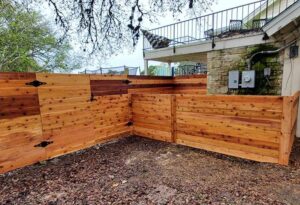
- Species match is first: Western Red Cedar next to SPF will always telegraph.
- Width + thickness must match, or your shadow lines won’t.
- Moisture content matters: install boards with similar dryness so gaps age consistently.
- Stain timing: New cedar needs 7–14 days to flash off oils before stain; older sections may need cleaning and a light brightener first.
- Sun map: South and west faces go lighter; expect to tone with stain choice to meet the middle. Start with a test board.
Austin-tuned specs box (copy/paste)
Assessment & structure
- Confirm posts are plumb and solid; if not, plan bell-bottom footing reset (30–36 in. depth, 10–14 in. bell).
- Rails must accept screws without crumble; replace any rail with dark halos or punky fibers at fasteners.
Picket replacement
- Match species (WRC), width, and thickness (⅝” or ¾”).
- Fasteners: stainless or hot-dip galvanized; offset slightly from old holes.
- Privacy tuning: side-by-side 1/8–3/16 in. gap; board-on-board no daylight at eye level.
- Bottom reveal: ¾–1 in. above grade; follow slope.
Panel swap
- Build to bay width; keep post centers on rhythm to avoid thin slivers.
- Pre-stain edges where possible; seal cut ends.
- Match top profile and height to adjacent bays; preserve corner visibility triangles.
Gate bay upgrades
- Boxed steel or cedar frame, through-bolted hinges with backing plates.
- Latch backed with a steel tab/plate; add a positive stop so the tongue hits home.
Finish
- Penetrating, UV-resistant stain; clean + brighten legacy sections so color lands together.
- Redirect sprinklers; keep mulch 1–2 in. below concrete caps.
Cost, schedule, and disruption
- Picket-by-picket is the surgical option: lowest material cost, more crew time.
- Panel swaps save labor on longer tired faces; upfront cost per bay is higher, but the look is uniform, same-day.
- Hybrid lets us pour structure dollars only where the line is actually failing (one bad post, a soft gate bay) and spend cosmetic dollars where it’s visible.
Most single-face picket swaps happen in half a day; multi-bay panel swaps are typically one day for standard runs, depending on access and landscaping.
Maintenance after a partial repair
- First 30 days: Light rinse only; let fresh cedar breathe before staining.
- After stain: Rinse dust and pollen quarterly; clear mulch off caps and keep bottom edges off wet soil.
- Storm check: Walk the line for new lean, especially at gates. Early tweaks prevent bigger fixes.
An on-site assessment checklist that our crews use
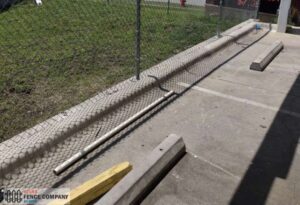
- Sight the line: Look for global lean, repeating sags every 24–32 ft, and gate drag.
- Post test: Push at mid-height; watch the cap at grade for movement. Mark any loose posts.
- Rail probe: Drive a screw near an old fastener; if it powders or spins, mark that rail for replacement.
- Board sample: Pull one picket from a bad area; check back face for rot and measure thickness/width to spec replacements.
- Exposure map: Note the south- and west-facing areas, irrigation zones, and shade pockets.
- Choose strategy:
- Structure good + damage local → picket replacement
- Multiple tired bays + structure OK → panel swap
- Structure failing in spots → hybrid (post/rail fixes + boards)
- Structure good + damage local → picket replacement
- Blend plan: Plan stain timing and cleaning so old/new land together.
- Gate bay: Check hinge-side straightness; add a boxed frame and backed hardware if needed.
- Safety & code: Keep visibility triangles, property lines, and easements in mind.
Close-out: Set care notes (sprinklers, mulch height, stain window).