
TL;DR
Bull panel fencing can deliver privacy-friendly sightlines without killing the breeze on Austin greenbelts—if you pick the correct gauge, aperture, and frame details. For most residential greenbelt edges in Austin, a 6-gauge welded wire with 4×4 in. aperture in a steel or hardwood frame hits the sweet spot: strong enough for pets and kids, transparent enough for views, and HOA-friendly with the correct top/bottom rails and stain. Use the specs below for cattle panel fencing posts, corrosion protection, and gate framing to keep the look “custom” for years.
Starting research? See examples and booking options on the Atlas Fence Austin homepage.
Why the bull panel belongs on Austin greenbelts
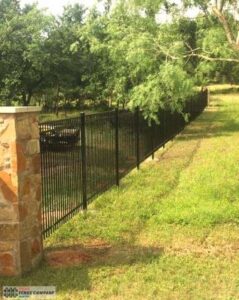
Bull panel (a welded wire grid set in a wood or metal frame) works when you want airflow, security, pet containment, and a “light” look. On greenbelts from Circle C to Steiner Ranch, the big wins are:
- Sightlines: You can keep the view of oaks and creeks without the “solid wall” feel.
- Breeze: Austin’s summer evenings need airflow—panels move more air than complete privacy runs.
- Maintenance: Fewer broad faces to UV-bake means less finish failure; frames and posts do the heavy lifting.
- Aesthetics: With right rail sizes and stain/tone, the fence reads as custom carpentry, not ranch pipe.
If you want a cohesive property look—privacy closer to the house and panels at the back—tie the two with consistent post species, cap/trim, and gate language. (See service options on Bull Panel Fence Installation — Austin.)
Aperture and gauge: what actually changes in your yard
Two numbers control the entire livestock experience:
Aperture (opening size)
- 4×4 in.: Most balanced for pets + kids + view. Hands can’t easily climb; balls don’t roll through.
- 6×6 in.: Airier and cheaper per square foot; good visibility for greenbelt views, but watch small-dog escapes.
- 2×4 in.: Tighter grid for small pets or coyote-aware yards; looks “busier,” slightly higher cost, more fastening points.
Gauge (wire thickness)
- 6-ga (beefy): Stiff, clean lines, resists denting from yard equipment. Our go-to for long, straight runs.
- 8-gauge (mid): Lighter feel and cost; fine if you have short spans or more frame members.
- 10-ga (light): Accent panels only; can oil-can on long spans and show waves.
The combo we recommend for most greenbelt edges: 4×4 in. aperture with 6-gauge wire in a robust frame. It delivers the “custom” look most HOAs prefer and keeps critter pressure manageable.
Frames that look custom (and last)
The frame is where the style happens—and where longevity lives.
Option A: Steel frame (powder-coated)
- Look: Slim, modern lines with minimal bulk around the panel.
- Longevity: Excellent—powder coat over galvanization where possible; seal cut edges.
- Maintenance: Spot-rinse; watch for scratches at gate latches and weed-whacker zones.
- Notes: Pairs well with steel posts for a cohesive, minimalist perimeter.
Option B: Cedar frame (select tight knot / clear where it shows)
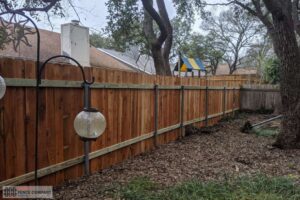
- Look: Warm, residential, easy to match with a wood privacy fence closer to the house.
- Longevity: Great with correct cap/trim and end-grain sealing. Use stainless or hot-dip galvanized fasteners.
- Maintenance: Plan a stain schedule. In full sun, use UV-resistant, penetrating finishes and mind mill-glaze prep.
Option C: Hybrid (steel posts & rails, cedar trim)
- Look: The “custom carpenter” aesthetic with steel skeleton strength.
- Longevity: Best of both worlds—steel carries loads, cedar provides texture and scale.
- Notes: Hide steel with cedar fascias where the HOA wants a wood appearance.
Framing rule of thumb: Let the frame dictate the sightline, not the panel. Keep rails aligned across bays so the fence reads like a single piece of furniture, not a set of rectangles.
Austin-specific constraints: HOAs, wildlife, and drainage
- HOAs: Many greenbelt lots allow “open” fences with dark tones—common language: non-privacy, dark neutral, consistent top line, no chain fabric. A bull panel often meets the spirit if the frame is tidy and finished in a dark color.
- Wildlife corridors: Consider coyote travel and deer pressure. A 4×4 in. aperture at the bottom limits intrusion while keeping runoff moving.
- Drainage: Greenbelt edges often have swales and sheet flow. Avoid solid kickboards that dam water; use open-bottom rails or notched trim to allow water to pass and prevent mulch migration.
- Wind: Preserve some wind relief with open apertures. Over-tightening with mid-span clips keeps the grid flat without turning the fence into a sail.
Specs box (copy/paste to your estimate)
Use this as your baseline and adjust for slope, run length, and HOA style notes.
- Panel: Welded wire, 6-gauge, 4×4 in. aperture, galvanized before welding or GAW where available; optional black powder-coat.
- Frame (steel): 1½×1½ in. square tube (0.083–0.095 wall) perimeter, 1×1 in. mid-stiffeners over 6+ ft spans.
- Frame (cedar): 1×2 in. stops with 1×4 face and 2×2 stiffeners; glue/seal end-grain; stainless screws.
- Posts: 2⅜ in. SS40/SS20 steel set 30–36 in. deep in concrete for level ground; bell bottom where expansive clay or slope.
- Rails: Top/bottom 1½×1½ steel or 2×4 cedar; align across bays for continuous sightline.
- Fasteners: Stainless or hot-dip galvanized; avoid electro-galv. For steel, use welded tabs or self-tapping with gasketed washers.
- Coatings: Galv + powder for steel; penetrating UV stain for cedar (cedar-tone, dark walnut, or black for “disappear into trees”).
- Clearances: Bottom gap 1–2 in. at lawn; 2–3 in. at greenbelt edge to pass water and mulch.
- Gates: Boxed steel perimeter with adjustable hinges; latch strike plate backed by a welded tab, not thin wood.
- Pets: Add bottom tension wire or narrow to 2×4 in. aperture for small breeds.
Gates that don’t sag: hardware & latch heights
Gates take daily abuse and telegraph quality. To keep the “custom” look:
- Hinges: Two 6-in. barrel hinges on 4–5 ft pedestrian gates; three on 6 ft wide or heavy frames.
- Latch: Keep latch 42–48 in. above grade for adult reach and hardware alignment; add inside pull as needed.
- Strike backing: Weld a small steel tab behind the latch’s strike plate to prevent dings into wood trim.
- Clear reveal: Maintain ⅛–3⁄16 in. on hinge and latch sides; set after stain cures to final thickness.
- Operator-ready: If you’ll automate later, pre-plan conduit and brace plates now.
(If your gate is the focal point of the house, coordinate with Wood Privacy Fence — Austin for matching caps, trims, and stain tones.)
How to plan a bull panel run on a slope (step-by-step)
Below is a homeowner-friendly plan you can bring to our estimator. We also embed these steps in our build workflow.
- Map the slope and swales.
- Walk the line with a 6–8 ft level or rotary laser. Mark high/low spots and any swale crossings. Note where you need extra bottom clearance.
- Choose rack vs. ste.p
- For mild slopes, rack panels in the frame so the top line flows. For steeper grades, step in consistent rises and use trim to disguise transitions.
- Lock aperture & gauge.
- Small pets or coyotes nearby? Choose 4×4 in. or 2×4 in. openings. Long runs with kids and sports gear? Pick 6-gauge for stiffness.
- Pick a frame language.
- Modern: slim steel frames, dark finish. Warm/residential: cedar face over a steel skeleton. Confirm HOA tones.
- Place posts and rails
- Set posts deeper near slopes (30–36 in.; bell bottoms for expansive clay). Align top rails across bays for continuous sightlines.
- Integrate drainage
- At swales, raise the bottom 1–2 in., omit solid kickboards, and use gravel pockets to allow water to flow under the fence.
- Pre-finish & seal
- Stain cedar pieces before assembly, where possible; touch up cuts. For steel, powder-coat and seal cut edges on site.
- Hang the gates last
- After frames are actual and finishes cured, hang and adjust gates. Set latches at 42–48 in.; confirm swing arcs clear grade.
Cost factors (where the money actually goes)
- Material grade: 6-gauge panels + powder coat + stainless fasteners raise cost but hold alignment and finish.
- Frame type: Steel frames cost more upfront but require less long-term maintenance; cedar trim adds labor but elevates the look.
- Site complexity: Slopes, rock drilling, tree roots, and drainage work impact hours and consumables.
- Gate count: Each gate is a mini-project (hinges, latch, bracing); expansive garden or mower gates move totals quickly.
- Finish: Factory powder + touch-up vs. field-stained cedar; pre-finishing saves callbacks.
Maintenance in Austin heat & storms
- Rinse and inspect twice a year—especially after oak pollen strings and storm debris.
- Touch up: Powder-coat scratches and stained cedar end-grain.
- Vegetation: Keep vines off panels; vines load the grid and trap moisture.
- Ground contact: Maintain the bottom gap; soil and mulch creep into the panels, accelerating corrosion.
Before you pick a panel over privacy
Bull panel shines on greenbelts and commercial properties with long views. Closer to patios and bedrooms, mix in privacy bays for sound attenuation and screening. This blended approach is common in Austin and keeps the lot open where it should feel open. For ideas on balancing airflow with privacy near greenbelts, see Privacy Fences on Greenbelt Lots — Austin.