
TL;DR
Austin’s wind bursts, straight-line thunderstorms, and saturated clay put fences under sudden, uneven stress. The smartest first move after a storm is a short, safe triage: power down hazards, document for insurance, brace loose sections, and protect pets and kids. Within 24–72 hours, decide what belongs in rapid repair (re-racking panels, hardware swaps, single-post resets) and what needs structural replacement (gate bays, post clusters, long runs with heave or subsidence). Permanent fixes in Central Texas last longer when they use: deeper posts (30–36″, typical for 6′ privacy), bell-shaped footings, rock-forward concrete mixes, upgraded gate frames/hinges, and drainage tweaks to prevent water from pooling at posts. Close with a clean inspection, a weather-aware cure window, and a plan to re-stain or seal once the lumber dries back to regular moisture.
What Austin storms actually do to fences
Austin’s “everything-at-once” weather—short, violent gust fronts; sideways rain; and flash ponding—rarely breaks a fence the same way twice. If you’re finding this right after a squall line ripped through, take a breath. Neighbors will swap stories, adjusters will be slammed, and you’ll see a dozen different fixes on your block. If you want a single, reliable playbook from a local crew, you’re in the right place with Atlas Fence Company.
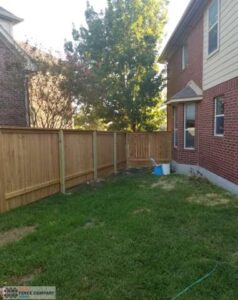
A few patterns we see all over Travis and Williamson County:
- Sail effect on privacy panels: Solid runs behave like a sail when wind goes from 0 to 40 mph in seconds. Leaning, post looseness, and panel racking follow.
- Soaked clay, then wind: Expansive clay loses friction when saturated, so posts loosen and twist more easily.
- Gate slam loads: Wind catches a gate like a wing. Undersized hinges and 4×4 posts bend or pull free.
- Tree and limb strikes: Impact damage commonly hides split rails, loosed screws, and micro-cracks at post/footing transitions.
- Pool edges and greenbelts: Water runs toward low ground. Footings that lack a crown end up sitting in a puddle.
Understanding the failure mode tells you whether a fast cabinet of screws will hold—or if you’re just delaying a larger failure by a couple of weeks.
First-hour safety triage and documentation
Before a single fastener turns, make the site safe:
- Kill the hazards: If fencing contacts power lines or pool equipment, keep clear and call the utility or a pro.
- Secure the yard: Pets and kids first—close gaps with temporary panels, caution tape, or even tied tarps until help arrives.
- Document for claims: Photograph wide-to-tight, capture property lines, and include measuring tape in a few frames. Record dates and storm details.
- Collect hardware: Hinges, latches, and post caps that “went missing” can be the difference between a minor repair and a complete replacement order.
Those 10–20 minutes of organized documentation pay off when adjusters ask for proof and when you compare bids apples-to-apples.
Temporary bracing, you can do the same day
Stop further damage and buy time for a proper fix:
- Leaning sections: Screw a 2×4 diagonal brace from post to ground stake; cross-brace long runs if you can.
- Flapping panels: Run temporary screws through the rails into the posts (match the existing layout so holes can be reused).
- Gate containment: For heavy gates, add a temporary drop rod or tie the leaf closed to prevent slam loads until hinges are corrected.
- Mud and heave: If water’s pooling at a post, rake a shallow trench to move water away; it can literally stop a slow-motion tip-over.
Temporary work is about stopping movement, not making it pretty. The goal is a controlled environment for permanent repairs.
How to tell repair from replacement
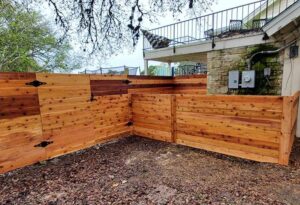
Here’s how we separate quick wins from sinks for future time and money:
Good candidates for repair
- Panels are racked out of square, but posts are plumb and solid.
- A handful of loose rails or pickets—especially where fasteners stripped under torsion.
- Single-post failures where the post base rotted or a footing cracked, but adjacent posts are sound.
- Gates where hinges, latches, or strike receivers are bent or worked loose, yet the frame is intact.
Likely replacement territory
- Multiple adjacent posts rotating or heaving in saturated clay.
- Gate bays are anchored to 4×4 posts that now rock or split.
- Long runs that took a twist: if you stand at one end and see a “wave,” the posts, as a group, lose alignment.
- Impact zones where rails shattered and pickets splintered—in practice, it’s faster and cleaner to rebuild than to “Frankenstein” a patch.
In short: if the structure moved (posts/footings), plan for replacement work. If attachments failed (fasteners/hardware/pickets), repair is usually innovative and economical.
Permanent fixes that survive Austin’s clay and heat
Once the yard is safe and you’ve chosen the right path, build back better with Central Texas realities in mind.
Rails and pickets
- Use corrosion-resistant screws with proper bite length; change the pattern to match horizontal vs. vertical grain.
- Stagger breaks and avoid “zipper lines” where every joint aligns; it’s stronger and looks better.
- Replace broken rails with kiln-dried stock. Wet lumber can shrink and expose fasteners later.
Posts
- Standard six-foot privacy runs do well with pressure-treated 4×4 posts; use 6×6 at corners, ends, and gate bays. For 8-foot privacy or horizontal designs, 6×6 across the run is smart.
- Seat posts in bell-shaped footings to fight uplift and seasonal clay movement.
- Keep the concrete crown above grade so water sheds away from wood.
Fasteners and connectors
- Exterior-rated structural screws and coated or stainless hardware outperform bargain bins, especially where irrigation overspray hits daily.
- Don’t reuse bent hinges or chewed lag screws; the threads are often fatigued.
Gate bays: the weak link that deserves upgrades
Storm repairs frequently become gate upgrades because gates multiply every load:
- Frames: Welded steel frames (powder-coated) or reinforced lumber frames outlive basic assemblies.
- Posts: Upgrade to 6×6 or steel posts with larger, deeper footings—think 14–18″ diameter and 36″+ depth when feasible.
- Hinges: Choose adjustable, ball-bearing hinges rated for your leaf weight. They let you re-tune after lumber acclimates.
- Latches & closers: Self-latching, lockable hardware keeps gates contained when wind hits; closers prevent slam loads.
- Stops: A simple gate stop block absorbs impact and saves hinges—often overlooked, always worth the minute to install.
A gate that opens like a dream after a storm isn’t luck—it’s design.
Concrete, posts, and footings that don’t wobble later
Concrete decisions you make today determine how your fence feels in six months:
- Depth: For most 6′ privacy lines, target 30–36″ into competent soil. If rock shows up, socket into limestone and rely on the rock bite for lateral resistance.
- Diameter: 10–12″ around 4×4; 12–14″ around 6×6; 14–18″ for gate posts.
- Mix: A 3,500–4,000 psi aggregate-rich mix with a tight water-to-cement ratio resists shrink and creep in Austin heat.
- Consolidation: Rod or vibrate to remove air pockets; they’re the voids that become wiggles.
- Cure: Give posts 24–48 hours before light framing in hot weather, longer for heavy gate leafs. Full strength arrives at ~28 days.
Avoid dry-setting when possible. In our climate, it cures unevenly and often cracks around the interface where you most need integrity.
Drainage, soil movement, and how to stop repeat failures
Storm repair isn’t complete until you’ve dealt with water:
- Regrade small swales to steer runoff away from footings. Even a shallow trough buys stability.
- Gravel aprons under gates keep splash-down from undermining latches and hinges.
- Confirm irrigation heads don’t spray posts for hours daily—redirect or swap nozzles.
If your line runs along a greenbelt or alley with chronic ponding, consider installing perimeter drains or stepping fence sections to keep water paths open rather than having them dammed by pickets.
Timelines: from emergency visit to final walkthrough
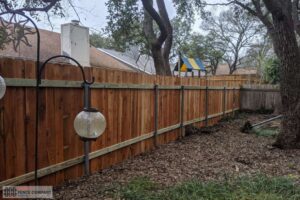
- Same-day/next-day triage: Secure the yard, brace danger spots, document.
- Within 24–72 hours: Scope repair vs replacement; order specialty hardware; schedule crew.
- Repair day: 2–6 hours for typical single-bay or cluster fixes; longer where rock drilling or multiple post resets are required.
- Cure + QC: Posts cure while braced; rails and pickets go on when footings support load. Final QC checks plumb, fastener pattern, and gate swing.
- Finish: Stain or seal once lumber moisture is back in spec (often a few weeks after storms), not while wood is soaked.
The goal isn’t just to be fast; it’s to be fast and done right so you don’t call us again after the next front.
Budget ranges and what affects cost
Repair-leaning scenarios
- Re-rack panels/rails, hardware refresh: typically the lowest cost and quickest turn.
- Single post reset with footing: moderate; price reflects digging, concrete, and cure management.
- Gate hinge/latch upgrade: varies with leaf size and material; great ROI.
Replacement-leaning scenarios
- Cluster of posts or long run: labor and concrete drive cost; if pickets are aged or mismatched, full replacement can be cleaner and not much more.
- Gate bay rebuild with 6×6 posts + steel frame: higher up front; dramatically lower maintenance over time.
Cost also fluctuates with access, rock, haul-off volume, and any HOA or pool barrier compliance work added to the scope.
Warranty, insurance, and permitting notes
- Warranty: A real warranty spells out what’s covered (materials, workmanship) and for how long. Storm forces are “acts of nature,” but quality repairs reduce future failures from normal use.
- Insurance: Your photo log and our line-item estimates make claims smoother. Some carriers require matching finishes—flag stain color early.
- Permits/HOA: Side and rear yard repairs rarely need a city permit if like-for-like, but HOAs often require notifications or re-approval. We’ll help assemble submittals where needed.
Mid-project checkpoints (and where to get help)
When you reach the point of choosing the path, it helps to weigh effort vs longevity. If a leaning section just needs fresh fasteners and a square-up, schedule quick, professional fence repair in Austin and we’ll stabilize it the right way. If posts have rotated in clusters or a gate bay tore loose, the smarter investment is full, code-clean fence replacement in Austin with upgraded posts, footings, and hardware. And if you want a homeowner-friendly checklist to prep before crews arrive (and to avoid repeat damage), bookmark our storm-prep and after-storm fence checklist for Central Texas—it covers tools, timelines, and how to photograph for claims without missing details.