
TL;DR
“Problem yards” in Austin aren’t problems—they’re normal. You’ve got expansive clay that swells after a thunderstorm, limestone shelves that stop post holes from being shallow, and drainage ruts that carry silt to the fence toe. The fix isn’t exotic lumber; it’s soils-first engineering at the ground line: correct embedment depth, core-drilling where rock is shallow, 6–8″ compacted gravel beds in every hole, crowned concrete collars that shed water, a 2–3″ base gap, and DG toe bands plus small swales to move water along the fence—not through it. Get those right, and your panels stay quiet, your gates still latch in August, and your stain schedule is predictable. If you’re starting from scratch, loop in the local team at Atlas Fence Company so post spacing, footing geometry, drainage, and gate framing are engineered together—not piecemealed in the field.
Why Austin yards behave “bad” (they’re just honest)
A fence is a ground-line system living in the weather. In Central Texas, expansive clays act like sponges—wet = swell, dry = shrink. If a footing traps water at the post, the socket “pumps,” loosens, and leans. On the west side, augers hit limestone shelves at 12–20″; installers who stop there (or cut posts to fit a shallow hole) create long levers that rock within a year. Add gust fronts sweeping down greenbelts and irrigation overspray, keeping the toe damp, and the weakest detail always telegraphs up the panel.
The antidote is simple: give the post a stable, draining pocket and give water somewhere else to go.
Soil diagnosis in five minutes (and what it changes)

Probe test: Drive a rebar or digging bar at several planned post spots.
- Sticky push with smear and suction: expansive clay. Expect water to linger after rain; you need gravel beds, geotextile “burritos” in fat clays, and crowned collars.
- Clink at shallow depth: limestone. Depth is not optional—core-drill 8–12″ into competent rock and set with non-shrink grout.
- Mixed results: transitional sites. Write a hole-by-hole spec—don’t force one embedment depth across the run.
Slope read: Sight the run from each direction. Where water naturally travels, plan a shallow upslope swale so sheet flow runs parallel to the fence, not into posts.
Wind read: Greenbelt edges and side yard wind tunnels require control joints and top caps for stiffness. Additionally, consider switching to shadowbox (airflow) or breaking long spans.
Footing geometry that survives clay swell and summer shrinkage
Think “drains like a roof, holds like a pier.”
Embedment depth (top of collar to post tip)
- ≤6′ fences: 30–36″ in clay.
- 7–8′ fences: 36–42″ in clay.
- If you hit rock shallow, see the limestone section next.
Hole geometry
- Diameter: 10–12″ for 4×4 posts; larger at corners, gates, and step transitions; 4×6 posts where loads collect.
- 6–8″ compacted clean ¾” rock at the bottom of every hole. In fat clays, wrap the rock zone in geotextile to stop fines migration.
Concrete placement
- Pour from the bottom up to avoid voids; rod lightly for consolidation.
- Finish a crown 1–2″ above grade, sloped away from the post—never flat.
Ground-line hygiene
- Keep a consistent 2–3″ base gap below bottom boards/rot boards to stop splash-wicking and to let wind “bleed.”
- Install a 6–12″ decomposed-granite (DG) toe band along muddy stretches; it dries fast, looks tidy, and discourages digging.
Limestone playbook: core-drill policies that prevent rocking corners
Stopping at 16–20″ because the rock “won’t let us go deeper” is how corners rock and gates drift.
What we do instead
- Core-drill 8–12″ into sound limestone: oversize the bore slightly, set the post in non-shrink grout, then form a standard collar above grade.
- Upgrade gate and corner posts to 4×6 (or steel) and increase hole diameter.
- Where boulders interrupt a neat circle, chip to shape or offset the hole—but never shorten the embedment.
Why it works
You create a proper socket in competent material, which resists rotation under wind and gate cycles even as the surrounding soil wets/dries.
Drainage choreography: swales, base gaps, rock curbs, and DG toes
Water that meets your fence should say “excuse me” and move along.
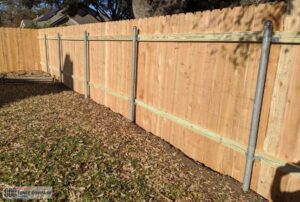
- Swales: carve a shallow upslope swale parallel to the fence so sheet flow doesn’t slam posts.
- Downspouts: extend discharges past the fence toe; splash blocks alone won’t cut it in a cloudburst.
- Rock curbs at dips: close low daylight with river rock or native stone, but leave weeps so water passes—not dams.
- DG toe band: that 6–12″ strip keeps mud off the toe, encourages fast drying, and makes stain/maintenance easier.
- Irrigation discipline: re-aim heads; set drip where possible. Sprinklers pounding the toe line create permanent damp zones.
If you want a focused companion checklist just for water control, pair this with our related explainer: Erosion & Drainage Around Fences: Keep Lines Straight.
Panel choices for windy corridors and sloped lots
Wind channels (greenbelts, hill gaps)
- Long, unbroken privacy runs like sails. Add hidden control joints every 24–32′ so gusts don’t rack the entire span.
- Consider a shadowbox for airflow on the worst exposure, or keep side-by-side/board-on-board, but maintain the base gap religiously.
Sloped grades
- Step panels where the slope is obvious; racking horizontal boards emphasizes the angle and reads sloppily.
- Close low daylight with rock curbs or skirt mesh, but don’t trap water—keep weep points.
Top caps
A top cap shades the end grain, stiffens the top edge, quiets chatter, and makes minor waves look laser-straight.
Gate bays on problem ground: frames, hinges, thresholds
Gates are your only moving parts—overbuild them.
- Frames: rigid steel frames for leaves ≥36″ wide.
- Posts: 4×6 (wood) or steel, set to the next embedment tier and larger hole diameters.
- Hinges: adjustable heavy-duty hinges; align barrels on the same axis; through-bolt hardware (lags loosen in moving soils).
- Threshold pad: small broomed-concrete pad pitched away from hinges; keep ~1″ clearance under the leaf so mud never drags.
- Latch placement: out of harsh west sun if possible; matte finishes run cooler for hands.
If you’ve got a chronic problem gate, fix the structure—not just the latch—by rolling it into targeted fence repair service in Austin. Re-posting with crowned collars and a threshold pad ends the seasonal shoulder-check.
Build week timeline (and where schedules usually slip)
Pre-build (3–10 days)
Site walk, probe holes for clay/limestone, utility/irrigation flags, access plan, neighbor notes.
Day 1 — Layout & selective demo
String lines at ground and top; mark step transitions; probe every third hole for rock; remove only what must go now so the yard stays secure overnight.
Day 2 — Footings
Dig to embedment targets; core-drill where rock is shallow; place 6–8″ compacted clean rock; pour from bottom up; finish crowned collars on every post.
Day 3 — Panels & rails
Hang panels with 2–3″ base gaps; add top caps and control joints; set rock curbs at dips.
Day 4 — Gates & hardware
Build on rigid frames; align hinges; pour/trowel the threshold pad; set latches to two-finger close.
Stain window
Book fall or mild spring; keep irrigation off faces 48–72 hours after coating.
Where schedules slip
- Wet clays after significant rain (holes pump water): we resequence to higher ground.
- Unflagged irrigation: leaks flood the toe; mark and cap zones before augers spin.
- Rock surprises without a core-drill plan: add the policy to your scope before Day 2.
For whole-yard rebuilds (new lines, gates, finishes) where the structure must align with the finish from day one, integrate roll planning into fence installation in Austin to ensure that spacing, hardware, and footings form a cohesive plan.
Quality control: a 12-point checklist for homeowners

- Embedment achieved (spot-check a few holes and the notes).
- Core-drill locations were recorded where limestone stopped, and holes were drilled shallowly.
- Gravel beds present—not mud—at the bottom of holes.
- Crowned collars 1–2″ above grade; none flat or bird-bathing.
- Base gap 2–3″ along all runs.
- DG toe band installed on muddy stretches; raked clean after the first hose-down.
- Swales cut where sheet flow heads into the line; downspouts extended past the fence toe.
- Control joints in long privacy runs; no billboard spans.
- Top cap straight and tight; no lifted ends.
- Gate posts upsized; hinges aligned; threshold pad pitched away; 1″ clearance under the leaf.
- Hardware exterior-rated; no mixed-metal stacks at hinge/latch plates.
- Cleanup: weeps and drain daylights visible; no concrete washout at the toe.
If any item is missed, most can be fixed the same day—ask for a tune-up before paying balances.